
Clayton Court Records After Arrest
The first record after an arrest is usually a jail booking record. In Clayton County, that record is tied to the Sheriff's Jail Docket Inquiry and may show the docket number, intake date and time, arresting agency, charge text, bond status, and release status. That booking record is not the same as the court case. Court records after a jail arrest begin to take shape when the person has early court review, a bond issue is addressed, and the prosecutor files or presents charges in Magistrate, State, or Superior Court.
That sequence matters because the jail charge can differ from the later court charge. A booking may list the offense used at intake. The prosecutor may then amend, reduce, dismiss, accuse, or indict the matter based on evidence and court path. For the custody side of the same event, use the Clayton County jail inmate records page. For the photo question, use the Clayton County jail mugshots page, since court case records should not be treated as a booking-photo database.
Process: Arrest, jail booking, first appearance or bond review, prosecutor filing, court case, disposition.
Clayton Court Case Inquiry
Clayton County publishes an official Court Case Inquiry wrapper that links to the public Clayton County Court Case Inquiry portal. The research for this project located the portal and confirmed that it is labeled for case search, but the exact rendered search fields were not fully captured. For that reason, a careful search should use the identifiers already found in the jail docket and avoid assumptions about any one field being required.
The official court portal is the most direct public starting point for charges filed after a Clayton County jail arrest. If a case is not visible, the reason may be timing, the wrong court level, a sealed or restricted record, or the need for clerk help. The justice-center setting can also confuse searches because the jail and many courts operate from the same larger complex, but the sheriff's booking record and the court case index are still separate systems.
The screenshot below comes from the official Clayton County Court Case Inquiry portal.
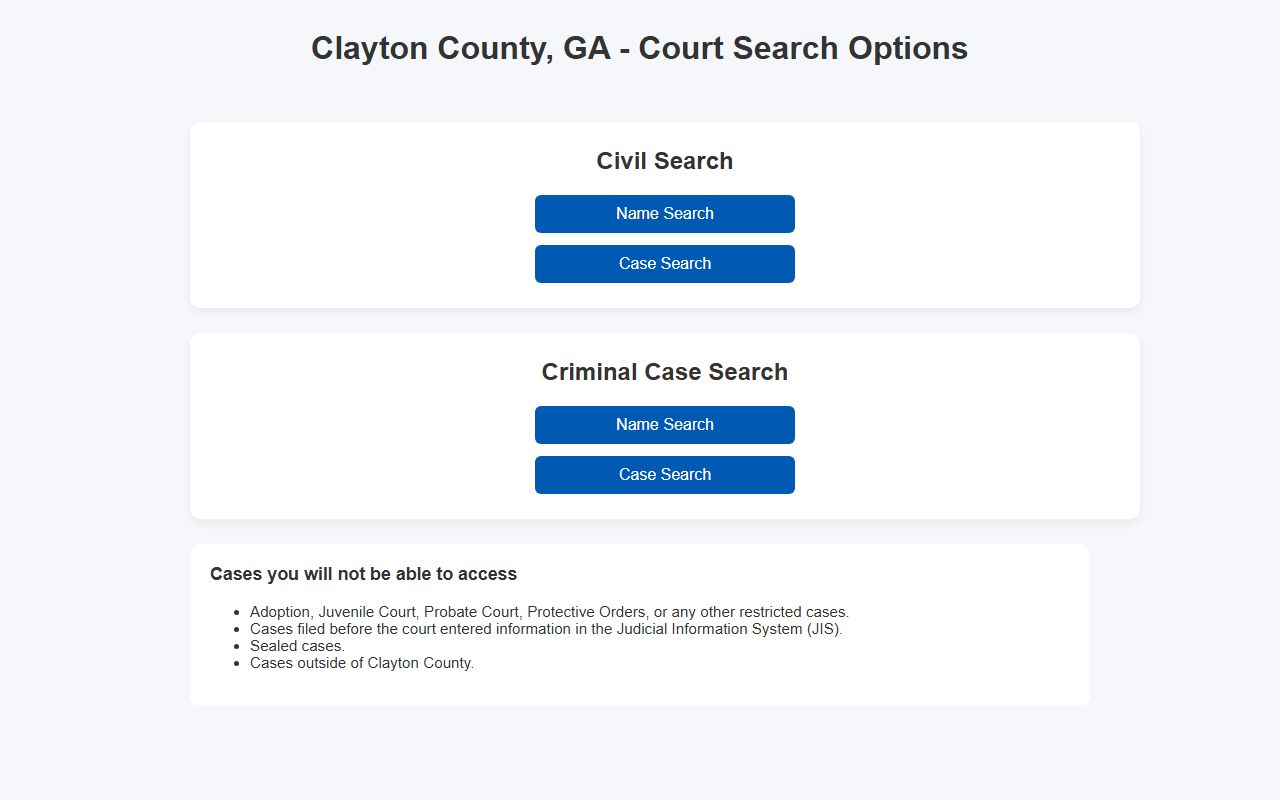
Use the portal as the case-search channel, then use the clerks when certified copies, older files, or missing case details require office review.
Find Clayton Court Records After Arrest
The most reliable search begins with the jail docket because that record fixes the identity and timing of the arrest. The docket may show a name, LE number, intake date and time, arresting agency, and charge text. Those details help separate people with similar names and help a clerk find the right case if the online index does not show it yet.
- Open the Sheriff's Jail Docket Inquiry and copy the name, docket number if shown, LE number, arresting agency, intake date, and charge text.
- Open Clayton County Court Case Inquiry and search with the available name or case identifier once it is known.
- Check the court level if the charge type is unclear. Magistrate Court may be involved in warrants and first appearance, State Court may handle many misdemeanors, and Superior Court handles felony matters.
- Compare the jail booking charge with the formal court charge. Differences are normal and should be read as case development, not as a simple error.
- If no record appears, contact the right clerk for certified copies, older records, sealed-record questions, or filing-status help.
The court-office path depends on the case type. The Clerk of Superior Court, Clerk of State Court, and Clerk of Magistrate Court each serve different case needs. When a filing cannot be located online, those offices are better sources than a broad web search.
Clayton Prosecutors and Court Records
The prosecutor's role is central to court records after a jail arrest. The Clayton County District Attorney site identifies District Attorney Tasha M. Mosley and describes the office as a voice for victims and an advocate for Clayton County citizens. In the arrest-to-court path, the DA handles felony prosecution after booking. That does not mean every jail charge becomes a DA felony case.
Many misdemeanor prosecutions can move through the Solicitor General and State Court path. Early warrant and first-appearance issues may involve Magistrate Court. A formal case record may show an accusation, indictment, amended charge, plea, dismissal, disposition, or other case event that is more precise than the brief charge text shown on the jail docket.
| Office or Court | Common Role After Arrest | What to Ask For |
|---|---|---|
| Magistrate Court Clerk | Warrants, first appearance, preliminary matters | Warrant or early hearing record if public |
| State Court Clerk | Many misdemeanor case records | Case file, docket, disposition, certified copy |
| Superior Court Clerk | Felony and higher-level case records | Indictment, accusation, plea, sentence, disposition |
| District Attorney | Felony prosecution | Charging status or victim-related case routing |
| Solicitor General | Many state-court misdemeanor prosecutions | Misdemeanor prosecution status |
Clayton Charging Documents
Charging documents are the bridge between a jail arrest and a court record. The exact document depends on the court path and charge level. A complaint may begin a lower-court matter or support a warrant process. An information or accusation is a prosecutor-filed charging document. An indictment follows grand-jury action and is common in serious felony cases. The label on the document tells the reader how the case entered court.
| Document | Who Uses It | What It Means in a Court Record |
|---|---|---|
| Complaint | Officer, complainant, court, or prosecutor depending on context | Starts or supports a criminal allegation, often near the warrant or early-court stage. |
| Information or Accusation | Prosecutor | Sets out formal charges without a grand-jury indictment, often in misdemeanor or eligible felony paths. |
| Indictment | Grand jury | States the charge after grand-jury action, usually in a felony case handled in Superior Court. |
A filing may use legal terms that differ from the short charge phrase on the jail docket. Read the formal charge, date filed, court, and later disposition together before drawing conclusions.
Clayton Charge Status Table
Charge status changes as the case moves. A person may be booked on one charge, accused of another, have a count reduced, or have a count dismissed. Court records after a jail arrest should therefore be read by charge count, not just by the first line of a result. A case can have several charges with different outcomes.
| Status | Plain Meaning | Search Tip |
|---|---|---|
| Pending | The charge or case is still open. | Check for the next hearing, bond order, or filing date. |
| Amended | The charge changed after filing. | Compare original and current charge wording. |
| Reduced | The charge was lowered to a lesser offense. | Read the final disposition before reporting the result. |
| Dismissed | The charge was ended by the court or prosecution. | Look for record-restriction eligibility if Georgia law allows it. |
| Nolle Prosequi | The prosecution discontinued that charge or case. | Confirm whether every count was affected or only one count. |
| Disposition | The final outcome for a charge or case. | Use disposition, not booking text, for the current court result. |
Bond After Clayton Arrest
Bond information often appears first on the jail docket, then court orders may shape release conditions. Clayton's inspected jail records showed charge-by-charge bond fields that can include "Not Ready," property bond text, cash bond text, and fee notes. The roster also warns that fees may not be included in the bond amount and that bond and fee amounts can change. A court record may later explain why a bond changed, why a person stayed in custody, or why a release did not occur after money was posted.
| Bond or Hold | How to Read It |
|---|---|
| Property bond | The docket says an approved property bond or full cash amount plus fees may satisfy a property-bond docket. |
| Cash bond | The docket says a cash-bond docket can only be satisfied by cash plus applicable fees. |
| Not Ready | Bond or release processing is not finalized on the displayed record. |
| No bond or hold | A court order, detainer, or another agency issue may prevent release. |
A detainer is a hold or request from another agency. It can affect release even when a local bond seems available.
Clayton Arrest Warrants
No official active Clayton County warrant search page was found in the official sources reviewed. That limits what can be stated with confidence. A served warrant may lead to booking at the Clayton County Detention Facility and later appear in the jail docket, but an unserved warrant may not show as jail custody. Bench warrants may be tied to the court that issued them, while arrest warrants may involve law enforcement and Magistrate Court.
Use official channels for warrant questions: the Clayton County Sheriff's Office, Court Case Inquiry when a related case is known, the Magistrate Court Clerk for warrant and first-appearance matters, and the county GovQA open-records portal for records not available online. If an in-person visit may lead to arrest, call the office or speak with counsel before appearing.
- Arrest warrant
- A judge's authorization to arrest a person.
- Bench warrant
- A judge's order often tied to failure to appear or another court violation.
- Search warrant
- Authority to search a place or thing, not a custody lookup.
- Fugitive or hold warrant
- A warrant or hold involving another county, state, or agency.
Clayton Charges vs Convictions
An arrest and a charge are not convictions. The Clayton jail docket itself notes that a displayed detention record does not imply conviction. Court records after a jail arrest can show allegations, prosecutor decisions, court rulings, pleas, and final dispositions. For that reason, any record check should separate the accusation stage from the final outcome.
| Point Compared | Charge | Conviction |
|---|---|---|
| Meaning | An allegation filed or listed in the case. | A guilty plea, guilty verdict, or qualifying adjudication. |
| Timing | Appears before final judgment. | Appears after plea, verdict, or sentencing action. |
| Proof Level | Based on probable cause or filing standards. | Based on proof beyond a reasonable doubt or a plea. |
| Public Reading | Do not treat as guilt. | Check sentence, count, and final disposition. |
Restricted Clayton Court Records
Georgia public-record rules generally support access to public records unless an exemption applies. The Georgia Open Records Act and the Attorney General's open-government materials are the main state-level access sources. Still, court and arrest information can be limited for reasons such as juvenile status, sealed records, restricted criminal history, ongoing investigations, or a court order.
| Point Compared | Public Record | Sealed or Restricted |
|---|---|---|
| Public View | Available through the court portal, clerk, or open-records path unless an exemption applies. | Hidden, limited, or withheld from routine public access. |
| Record Existence | The case or docket entry can be viewed or requested by the public. | The record may still exist in court, clerk, or agency files. |
| Access | Public users can inspect or request the available record. | Clerks, courts, or law enforcement may retain limited official access. |
| Best Source | Use Court Case Inquiry and the clerk that holds the case. | Ask the court, clerk, or Georgia record-review channel tied to the disposition. |
The Georgia Attorney General open-government FAQ says agencies must respond within three business days or explain timing, costs, and legal authority for withheld records. That rule helps with open-records requests, but it does not override a valid sealing order or other exemption.
Certified Clayton Court Copies
Online case inquiry is useful for a quick search, but certified copies come from the clerk that maintains the case record. Ask for the case number if known, the defendant's full name, the court, filing date or arrest date, and the exact item needed. A certified disposition, indictment, accusation, sentencing order, or dismissal entry is more useful than a broad request for everything after an arrest.
For records not published in the court portal or jail docket, use the official Clayton County open-records portal. The request should name the office likely to hold the record and should include enough detail to avoid delay. Jail records, court records, and prosecutor records are separate sources, so a request may need routing.
Important: Jail, court, and custody details are not consumer reports and must not be used for employment, credit, housing, insurance, or similar screening decisions.